Loading…
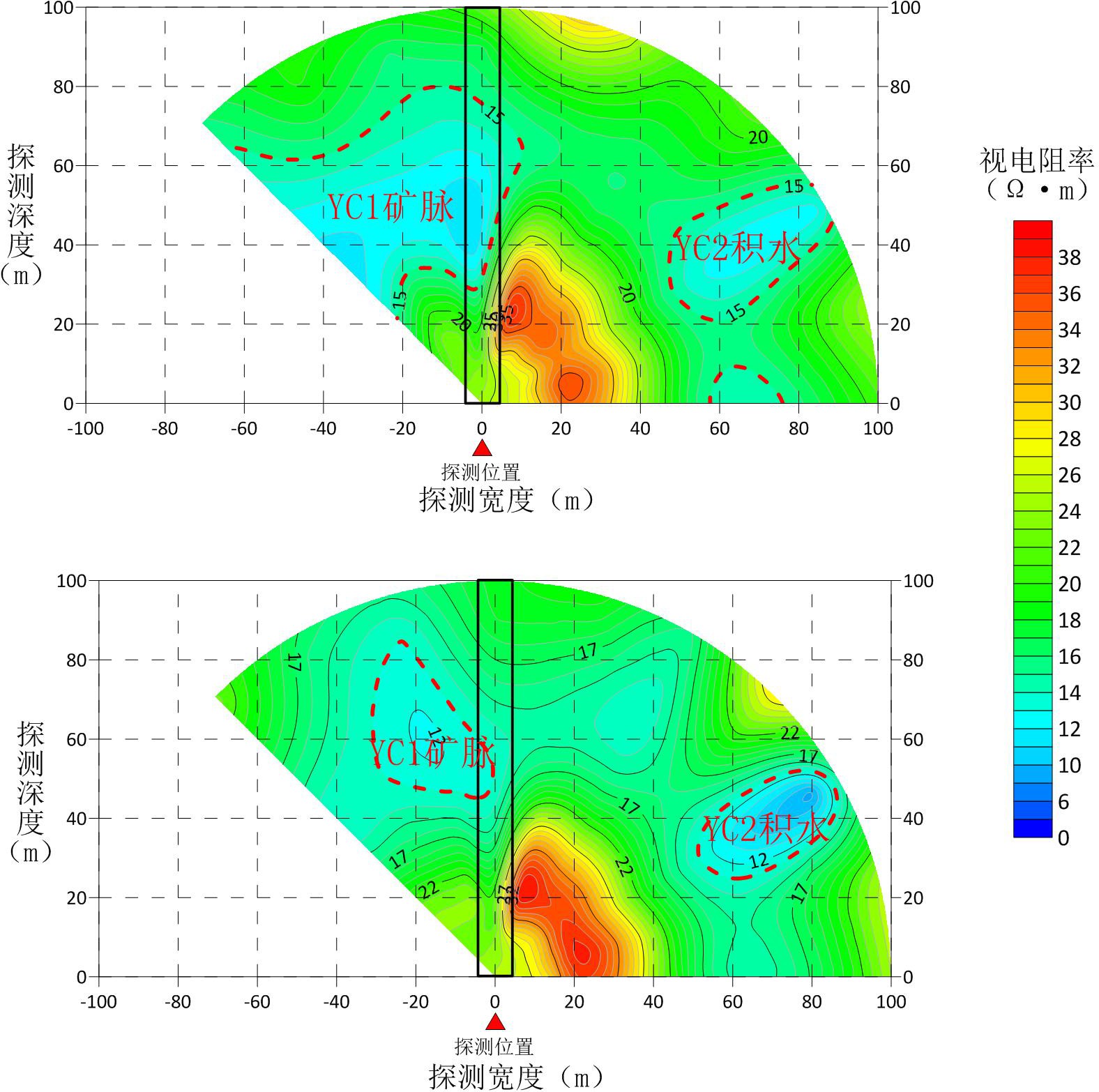
A lead-zinc mine in the Beishan Mining area of Hechi, Guangxi has complex hydrogeological conditions. Underground, there’s a threat from water accumulation in mined-out areas while there’s also a need to delineate the lead-zinc ore bodies in the mining sections. Commissioned by the mining company, we used the GT-30 transient electromagnetic instrument to carry out both water and mineral exploration underground at the same time.
Both aquifers and metallic ore bodies show up as low-resistance, so figuring out the difference between the two in complex hydrogeological conditions is tricky. On site, we used a fan-shaped setup to detect the target area from multiple angles, and combined this with the known spatial relationship between the ore veins and the mined-out water-prone zones to make a comprehensive interpretation: the YC2 anomaly was identified as an aquifer in the mined-out area, and the YC1 anomaly was interpreted as a lead-zinc ore vein (ore body).
After actual exposure verification, the locations of both the aquifer and the lead-zinc ore body matched the survey results completely.
This work shows that the transient electromagnetic method can achieve both water and mineral exploration underground. In metal mines with complex hydrogeological conditions, it can provide a basis for both water prevention and mineral exploration, improving the overall efficiency of underground geophysical surveys.