Loading…
Liuzhou is a typical karst-developed city, and building light rail lines requires a high level of understanding of underground caves and fracture zones. At the request of the client, our company conducted a transient electromagnetic survey along a section of the Liuzhou light rail.
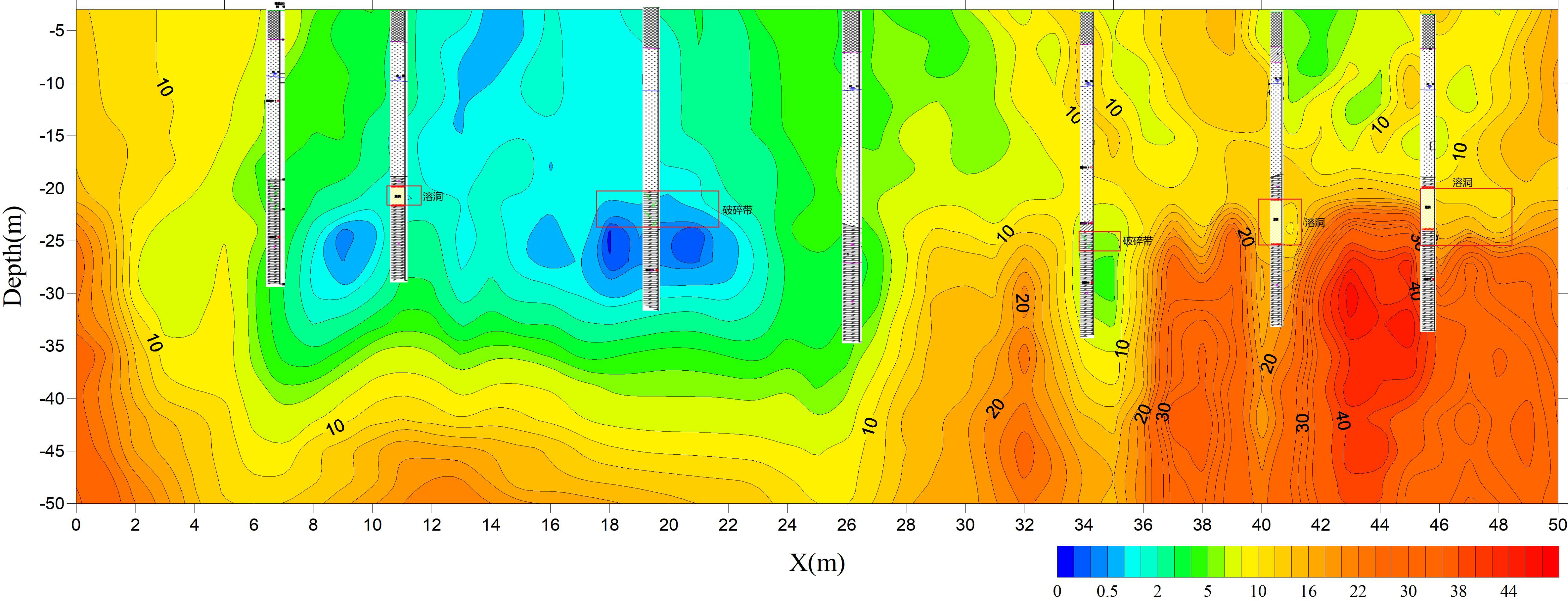
The survey area is underlain by carbonate rocks, with developed karst and fractured rock masses. The caves and fracture zones are not obvious on the surface, so geophysical methods combined with drilling are needed for control. On-site, survey lines were laid out along the route, and a GT-30 transient electromagnetic instrument was used to detect anomalies, using low-resistivity zones to delineate the range of fractures and karst development.
The positions of fractures and karst determined from the survey sections basically matched the locations of caves and eroded fracture zones revealed by subsequent borehole logs: anomalous geophysical sections corresponded to drill losses, water inflows, and filled cave locations, while normal resistivity sections corresponded to intact limestone.
This survey shows that the transient electromagnetic method works well with drilling for urban light rail karst investigations. It can effectively delineate the lateral distribution of karst and fracture zones, providing geological data for route design and pile foundation construction.