Loading…
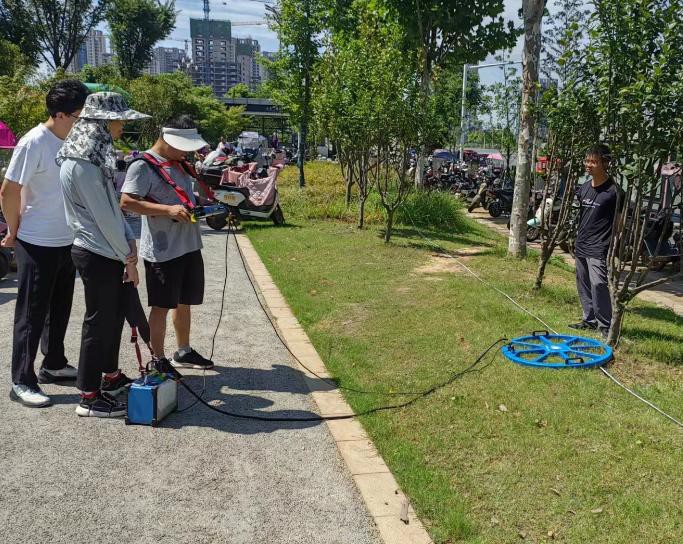
During the construction of a certain metro in Wuhan, it was necessary to determine the planar location and burial depth of a deeply buried concrete water pipeline within the station area, in order to provide avoidance references for subsequent foundation pit excavation and underground structure construction. Commissioned by the client, our technical personnel carried the GT-30 transient electromagnetic detection system to the site to carry out specialized detection.
The target pipeline is a concrete water supply pipe with a diameter of approximately 1.1 meters and a burial depth of up to 12 meters. Due to the great depth, relatively small target diameter, and the site being in an urban traffic area, there were strong electromagnetic and vibration interferences. Prior to construction, the client had attempted investigation using multiple methods including ground-penetrating radar, high-density electrical methods, and seismic reflection waves, but none achieved satisfactory results.
Given the characteristics of the large burial depth and the weak conductivity contrast with the surrounding rock, a coplanar equivalent reverse magnetic flux transient electromagnetic device was used in this study. Survey lines were arranged perpendicular to the presumed pipeline direction, using the electrical difference between the water body inside the pipe and the surrounding soil to delineate anomalies. The GT-30 device not only overcomes the shallow ‘blind zone’ problem of traditional transient electromagnetic methods but also ensures sufficient detection depth.
The detection profile shows a distinct closed low-resistance anomaly at a depth of approximately 12 meters. The location and scale of this anomaly are highly consistent with the known pipeline, and the detection results match the actual conditions, providing reliable underground pipeline information for the design and construction of the metro station.
This case demonstrates that the transient electromagnetic method has good detection capability for deeply buried, non-metallic (concrete) pipelines and is particularly advantageous for the survey of deep-buried pipelines where conventional methods such as ground-penetrating radar fail.