Loading…
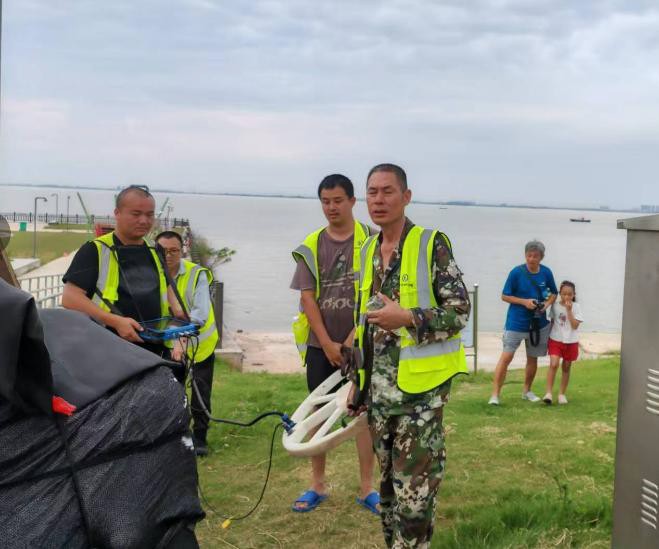
In July 2024, a section of the levee at Dongting Lake in Yueyang, Hunan developed a seepage risk, with the exact location of the leakage unknown, posing a serious threat to the levee's safety. After receiving an urgent request from the client, our company immediately organized technicians to bring the GT-30 transient electromagnetic detection system to the site to assist in the emergency levee survey.
Emergency conditions demanded extremely fast detection, and the levee's soil had a high moisture content with weak electrical contrast between the problem area and surrounding soil, making it difficult to pinpoint. Upon arrival, the technicians quickly set up survey lines along the risky section and continuously collected data using a coplanar equivalent magnetic flux device, focusing on tracking low-resistance water-rich anomalies inside the levee.
The on-site detection was completed in about 2 hours, identifying the location and extent of the seepage channels on the apparent resistivity profile. At the same time, the client conducted a high-density electrical survey, which took about 26 hours to complete. Comparing the results from both methods, the location of the seepage anomalies was basically consistent.
The transient electromagnetic method achieved the same results as the high-density electrical method in just about 2 hours of work, saving valuable time for emergency response and fully demonstrating the effectiveness and efficiency of the GT-30 system in emergency situations.